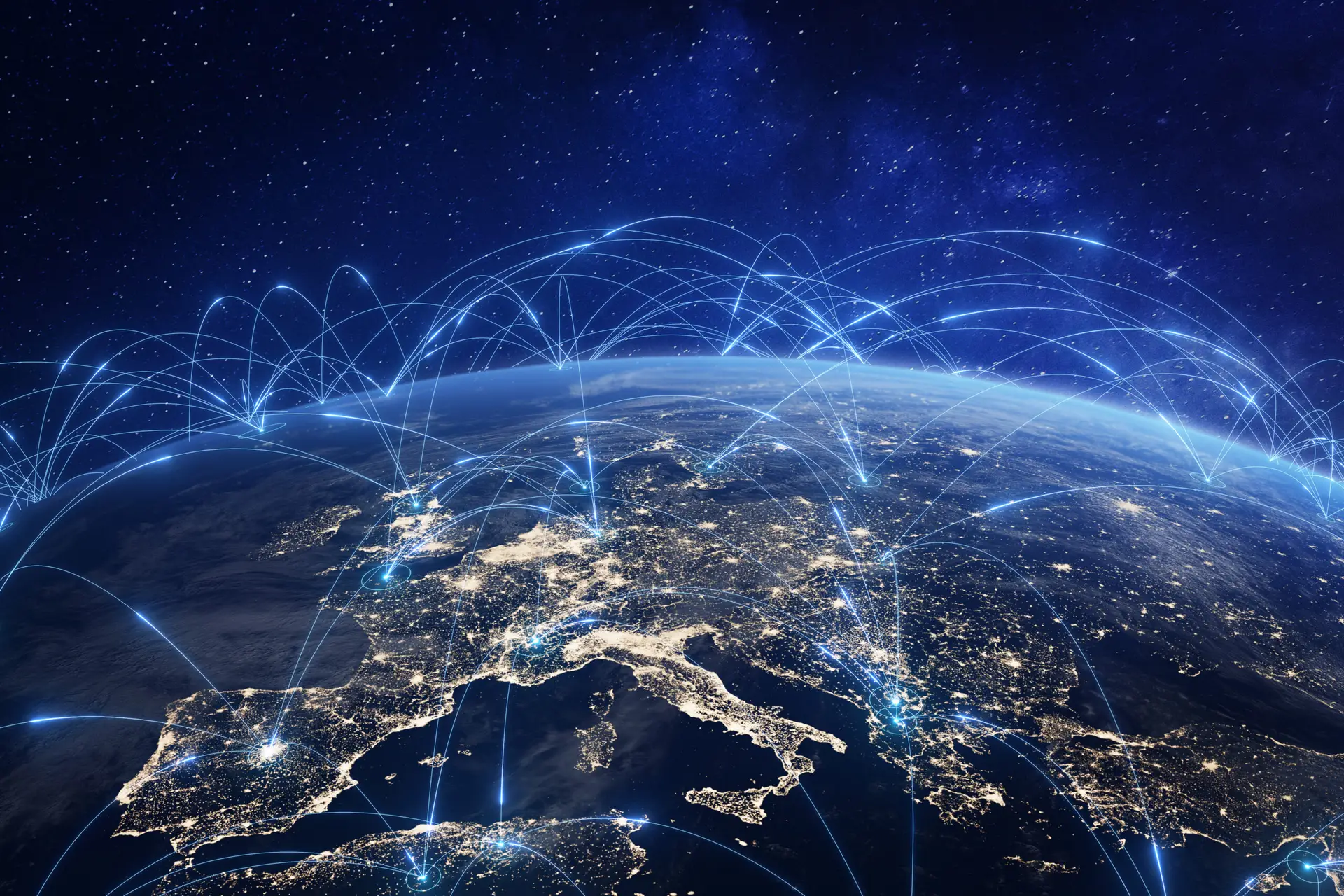
The quantum internet and the associated quantum key distribution networks (QKD-networks) represent a significant advance in communication technology. Based on the Principles of Quantum Mechanics They offer the potential for ultra-fast, tap-proof data transmission. This article provides an easy-to-understand overview of these technologies, how they work, current developments, challenges, and future applications.
What is the quantum internet?
The quantum internet aims to, Quantum computer and to interconnect other quantum resources over long distances in order to enable applications that cannot be realized with classical networks. A primary goal is secure communication through quantum key distribution, in which security is based on the laws of physics rather than on computational complexity, as is the case with classical encryption methods.
The Quantum Key Distribution (QKD) uses the principles of quantum mechanics to generate secure keys between communication partners. A well-known protocol is the BB84 Protocol, in which individual photons can be used in different polarizations to generate a key. An eavesdropping attempt would affect the qubits (qubits) interfere and are therefore detected immediately, since the measurement reflects the state of the photons modified. This ensures secure communication that cannot be eavesdropped on.
Recent Developments in the Quantum Internet and QKD Networks
Around the world, researchers and companies are working intensively on bringing the quantum internet to fruition and implementing QKD-Networking. Here are some notable advances:
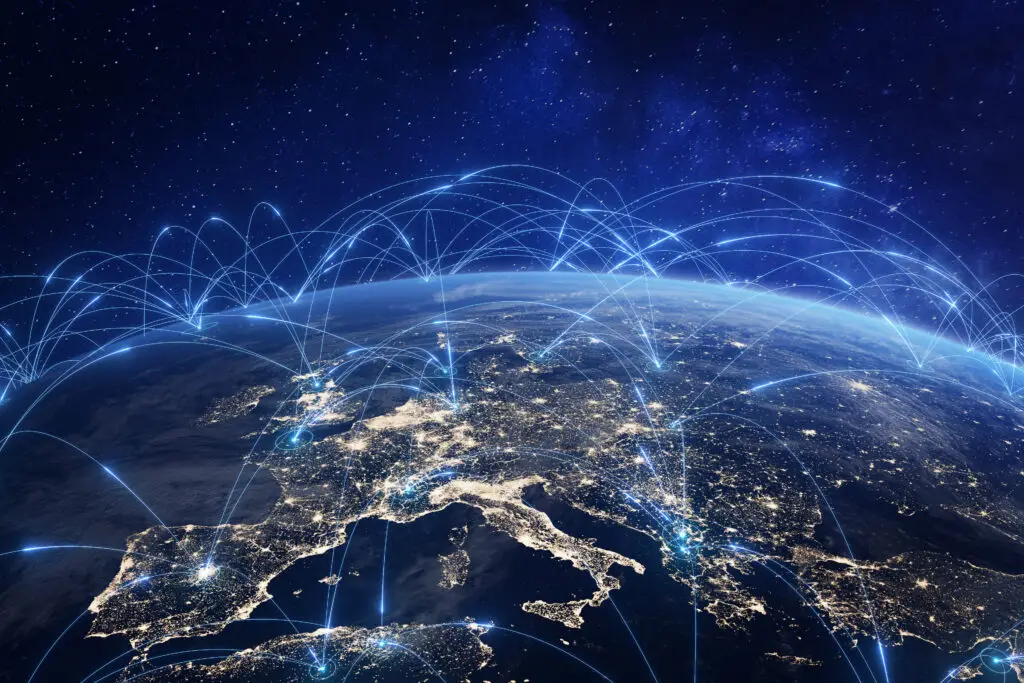
Germany: In November 2024, a test route over 900 kilometers long for quantum-encrypted data communication between Berlin and Bonn was put into operation. This project, funded by the Federal Ministry of Education and Research (BMBF), demonstrates the practical application of QKD over long distances and uses existing fiber-optic infrastructure.
International Assessment of QKD-Technologies: In January 2024, the Federal Office for Information Security (BSI), together with partner agencies from France, the Netherlands, and Sweden, published a position paper assessing quantum key distribution. The paper emphasizes that, despite the potential of QKD currently the Post-Quantum Cryptography (PQK) is preferred because it can be implemented on traditional hardware and is available quickly.
China: With its “Micius” quantum satellite, China demonstrated as early as 2016 that quantum key distribution is possible over thousands of kilometers. This enabled secure communication between Beijing and Vienna.
USA: Research networks such as those at the University of Chicago and Argonne National Laboratory are working on quantum test beds that are intended to serve as the foundation for future quantum communication networks.
Challenges in Building the Quantum Internet
Despite the enormous potential, scientists and engineers face several challenges:
- Data loss over long distances: photons, which are transmitted via fiber-optic cables, can be lost, resulting in a loss of information. In the classical Internet, signals can be amplified by repeaters. In the quantum Internet, this is more complicated because it is not possible to copy quantum states. Therefore, Quantum Repeater developed that can store and transmit the quantum state.
- Sensitivity to environmental factors: Quantum systems are extremely sensitive to disturbances such as temperature changes or electromagnetic fields, which can affect the stability of the transmission.
- Scalability: Currently, only small quantum networks exist. Scaling up to a global network will require significant technological advances and standardization.
When will the quantum internet arrive?
Experts predict that the first fully functional quantum communication networks will emerge within the next 10 to 15 years. Initially, hybrid systems that combine classical and quantum communication will be developed. This could proceed in the following steps:
In the short term (through 2027)
Establishment of national QKD networks for secure government and corporate communications.
In the medium term (through 2035)
International connections between these networks via quantum repeaters and satellites.
in the long term (starting in 2040)
A fully interconnected global quantum internet capable of interacting with classical networks.
The potential applications of the quantum internet extend far beyond secure communication. Since any attempt to eavesdrop inevitably alters the state of the transmitted qubits, no one can intercept data without being detected. This is particularly true for Government and Military Communications, but also for Financial Transactions relevant. Quantum computers could be connected to each other via the quantum internet and work together to solve complex problems—for example, in the Drug Development or the Simulation of chemical processes. Synchronizing high-precision atomic clocks could improve navigation and communication systems, which is particularly important for Space Missions or High-Frequency Trading is important. Major technology companies such as IBM and Google are already working on, Cloud Services to secure it using quantum technology in order to protect data from future quantum attacks.
The quantum internet is no longer science fiction—it is on its way to becoming a reality. The technological hurdles are significant, but advances in research show that we will experience a completely new form of digital communication in the coming decades. While commercial deployment is still a few years away, the first practical applications are already on the horizon. Companies and governments that invest in this technology early on could gain decisive advantages in digital security and data processing.
Sources:
https://www.bmbf.de/SharedDocs/Kurzmeldungen/DE/2024/11/quantenkommunikation.html
https://www.nat.tum.de/nat/aktuelles/article/quanteninternet-das-groesste-problem-ist-datenverlust