
Wie sicher ist Quantenkommunikation unter realen Bedingungen – und was können gezielte Angriffe über ihre Stärken und Schwachstellen verraten?
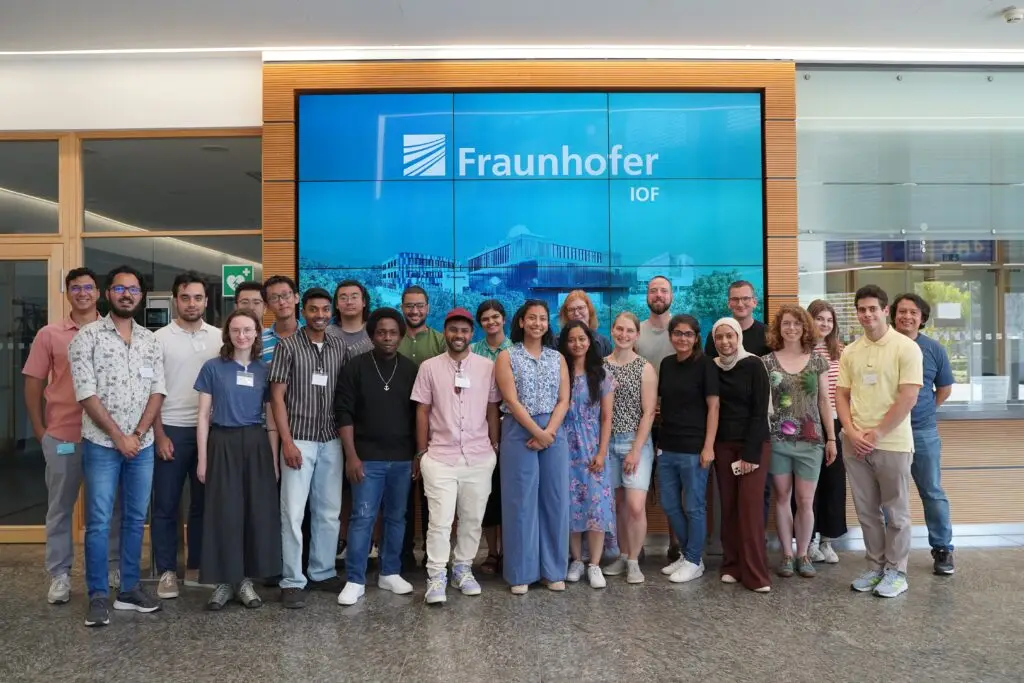
Beim zweiten Quantum Hackathon am Fraunhofer IOF in Jena gingen rund 20 internationale Teilnehmende diesen Fragen praktisch auf den Grund.
Zwei Tage lang arbeiteten sie gemeinsam daran, ein reales Quantenkommunikationssystem zu untersuchen, Signale abzufangen und die Auswirkungen ihrer Eingriffe auszuwerten.
What is quantum hacking?
Auch quantensichere Systeme müssen sich in der Praxis bewähren
Quantenkommunikation nutzt einzelne Lichtteilchen – sogenannte Photonen – und deren quantenphysikalische Eigenschaften, um Informationen besonders sicher zu übertragen. Ein unbemerkter Zugriff auf eine quantenverschlüsselte Verbindung ist grundsätzlich nicht möglich: Jeder Eingriff verändert das System und kann dadurch erkannt werden.
Das bedeutet jedoch nicht, dass reale Quantenkommunikationssysteme automatisch unangreifbar sind. Sie bestehen aus optischen und elektronischen Komponenten, Messgeräten, Steuerungen und Software. Diese praktische Umsetzung kann Eigenschaften oder Schwachstellen aufweisen, die sich gezielt untersuchen lassen.
Quantum Hacking
setzt genau hier an. Es geht nicht darum, die Gesetze der Quantenphysik zu umgehen. Stattdessen werden reale Systeme unter kontrollierten Bedingungen angegriffen, um besser zu verstehen, wie sie reagieren, welche Spuren ein Eingriff hinterlässt und wie zukünftige Anwendungen noch robuster gestaltet werden können.
Quantum hacking does not mean circumventing the laws of quantum physics—that is impossible. Instead, attackers exploit the properties or limitations of the hardware or protocols used. Such attacks highlight how important it is to carefully design and thoroughly test QKD systems to ensure that the keys generated remain truly secure.
Zwei Tage voller Ideen und Experimente
Nach der erfolgreichen ersten Ausgabe im Jahr 2025 kehrte der Quantum Hackathon am 29. und 30. Juli 2026 mit einem erweiterten zweitägigen Format nach Jena zurück.
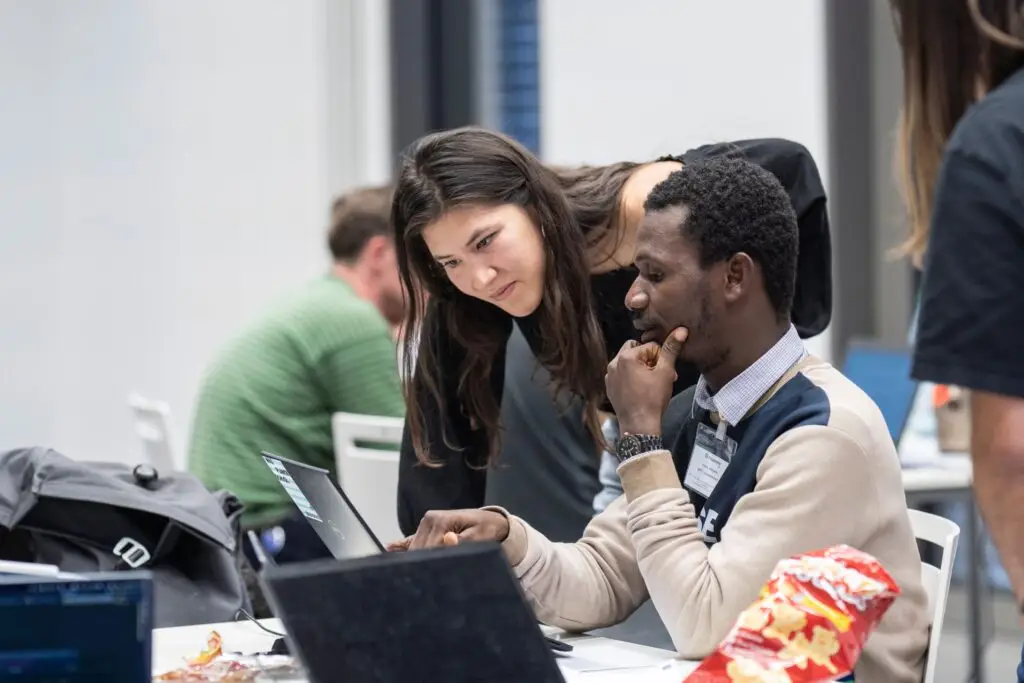
Zu Beginn vermittelten Fachleute die Grundlagen der Quantenkommunikation und führten in die Funktionsweise des experimentellen Systems ein. Anschließend entwickelten die Teilnehmenden in kleinen Gruppen eigene Ansätze für die gestellte Aufgabe.
Im Mittelpunkt stand dabei nicht allein die Frage, ob sich ein Signal abfangen lässt. Entscheidend war, die gewonnenen Daten richtig zu interpretieren und zu untersuchen, wie sich der Angriff auf das gesamte Kommunikationssystem auswirkt.
So verband der Hackathon theoretisches Wissen mit praktischer Laborarbeit, gemeinsamer Fehlersuche und kreativem Experimentieren.
After an initial phase in which software-based strategies and attack concepts were developed, the teams put their ideas into practice in the lab. To do so, they had access to an arbitrary waveform generator (AWG), a phase modulator, an intensity modulator, and other optical components. Using this equipment, they were able to manipulate the quantum signal between Alice (the sender) and Bob (the receiver) and then observe how their interventions affected the error rate (Quantum Bit Error Rate, QBER)—an impressive example of how every attack leaves traces.
The three teams – EVEL, Qrackers and JENeavesdroppers – developed a wide variety of creative approaches in the process. The direct comparison between theoretical expectations and the system’s actual behavior led to numerous “aha” moments and highlighted why quantum communication is considered a future-proof technology.
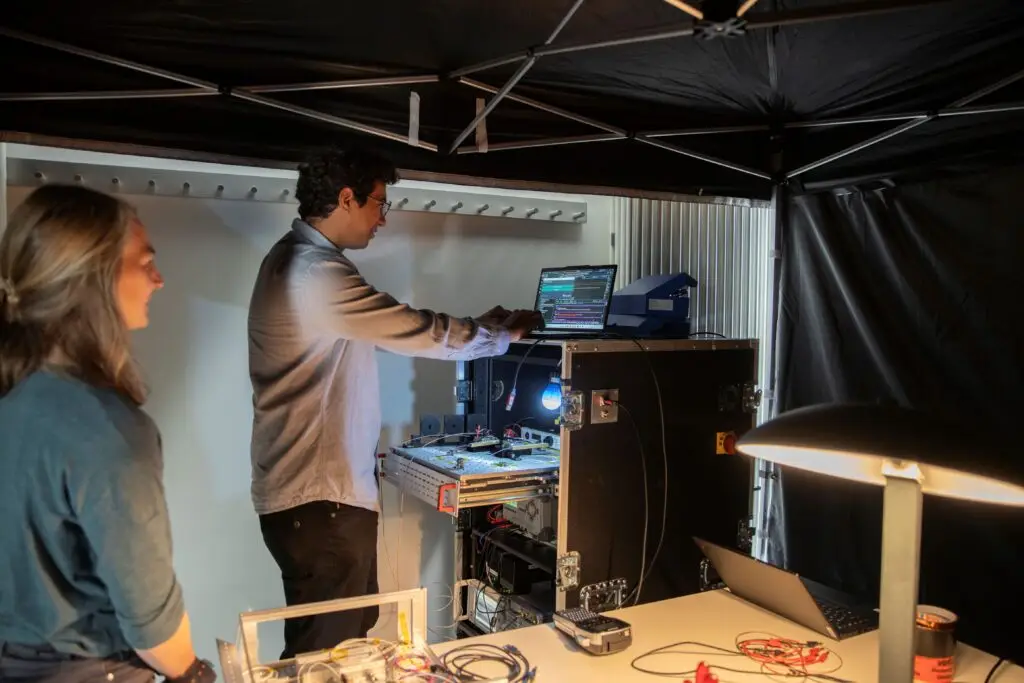
The hackathon used a testbed consisting of three functional units
Alice (Source)
Generates weak coherent light pulses and encodes random bits using time bins (early/late) and relative phase. The pulses are transmitted to Bob via an optical fiber.
Bob (Detector)
It measures the incoming pulses using randomly selected bases via single-photon detectors and communicates with Alice via a classical channel to determine the bits suitable for key generation.
Eve (Hacker)
Participants were able to manipulate the quantum signal using the laboratory equipment provided, including an arbitrary waveform generator (AWG), a phase modulator, an intensity modulator, and other optical components.
This setup made it possible to perform targeted manipulations on the quantum signal and observe their effects on the quantum bit error rate (QBER).
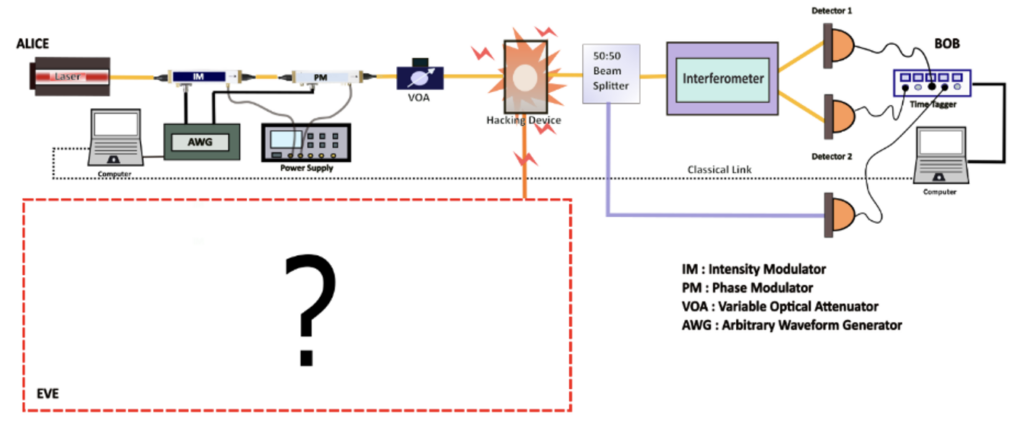
Fig. 1. Experimental setup for the Quantum Hackathon.
The hackathon produced many memorable moments
The teams developed creative approaches to test the system's limits.
The direct comparison between theory and the system's actual behavior led to numerous “aha” moments.
Participants learned firsthand why quantum communication is considered a future-proof technology: every attack leaves measurable traces.
Comments from participants
„
Despite having no prior knowledge, the introduction and lectures helped me gain a solid understanding of QKD—and I really hope you continue to offer such practical, personally guided hands-on hackathons in the future.
„
„
The hackathon challenge was based on a realistic QKD scenario—a photon-number-splitting attack—and demonstrated how imperfections in light sources can be exploited. By working on a photonic setup with lasers and detectors, participants were able to experience firsthand the interplay between theory and experiment.
„
„
Feedback from ParticipantsThe Quantum Hackathon at Fraunhofer IOF was a warm and inspiring introduction to my future field of research—at the intersection of quantum technologies and cybersecurity. It was superbly organized, enriching, and a lot of fun. I really hope to reconnect with this community soon. Maybe even at the next event!
„
Outlook: What's next?