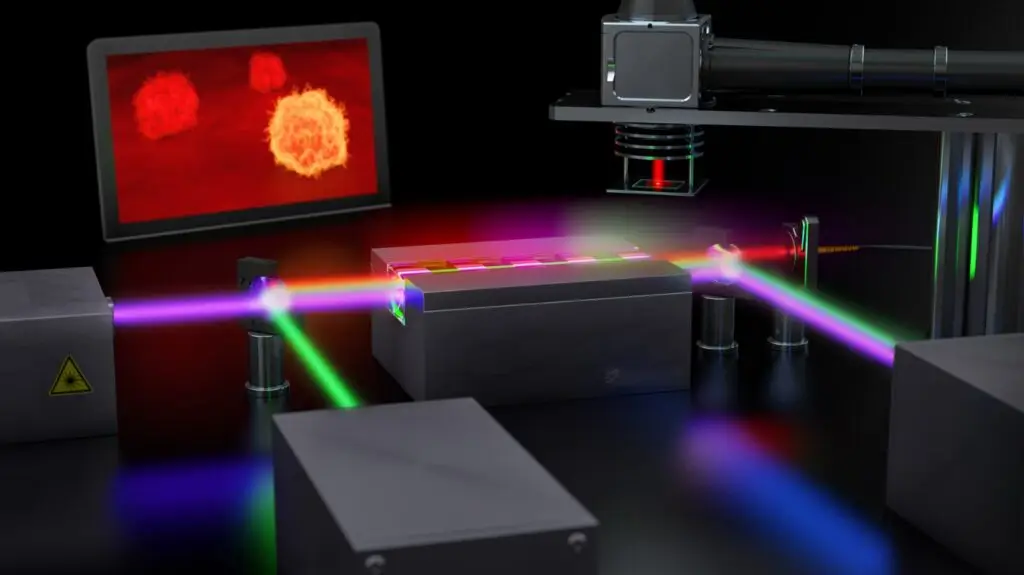
Quantum Key Distribution (QKD) is a revolutionary technology based on the principles of quantum mechanics that enables absolutely secure communication. While traditional encryption methods may be vulnerable to advances in computing power, QKD offers a mathematically secure method for sharing secret keys between two parties. This is based on the unique properties of quantum objects, such as the principles of Quantum superposition and the Entanglement. QKD is for the Quantum Communication of crucial importance because it provides a level of information security that cannot be achieved through traditional methods.
Basic Principles of QKD
QKD protocols utilize the fundamental properties of quantum mechanics to generate secure keys. Essentially, the idea is that any attempt to eavesdrop on a quantum communication channel disrupts the transmitted quantum measurements, which can be detected by the communicating parties. This disruption allows them to verify whether the transmission was secure and whether the key has been compromised. The two parties are also referred to as Alice and Bob. Alice is the sender of the encrypted message, while Bob is the recipient. There are various QKD protocols designed to address different security needs, meet technological requirements, and optimize efficiency. Some protocols are easier to implement or offer specific advantages in terms of error correction or areas of application. This diversity makes it possible to select the appropriate protocol for different requirements and operating conditions. Here are three of the best-known QKD protocols, which are based on the principles of quantum mechanics:
BB84 Protocol
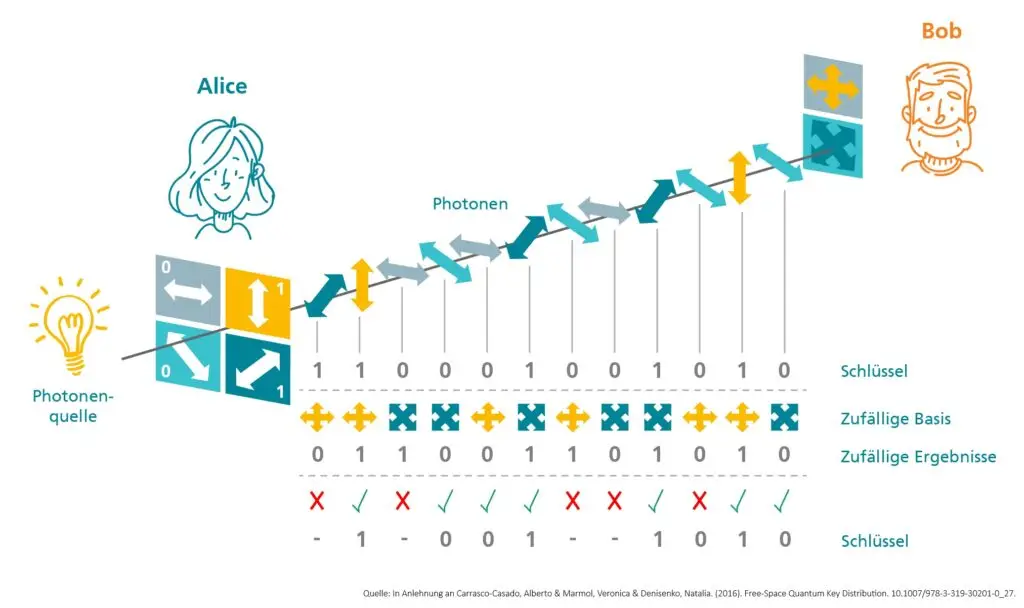
The BB84 protocol is the first and most widely used QKD protocol, developed by Charles Bennett and Gilles Brassard (1984). It operates on the basis of qubits or qubits, which are encoded in different states. Imagine that the sender (Alice) qubits prepared in one of four possible states: two states in the basis represented by vertical and horizontal polarizations, and two states in the basis represented by diagonal Polarizations are displayed. The receiver (Bob) measures these qubits using randomly selected bases. Once the transmission is complete, Alice and Bob compare which bases they used to perform the measurements. They retain only the results for which the bases used match, and discard the remaining data. Through this process, they generate a shared secret key. Any attempt to eavesdrop would disturb the qubits, thereby causing anomalies in the measurement results that can be detected.
Strengths:
- Simplicity and widespread adoption
- Robust security proofs based on the principles of quantum mechanics
E91 Protocol
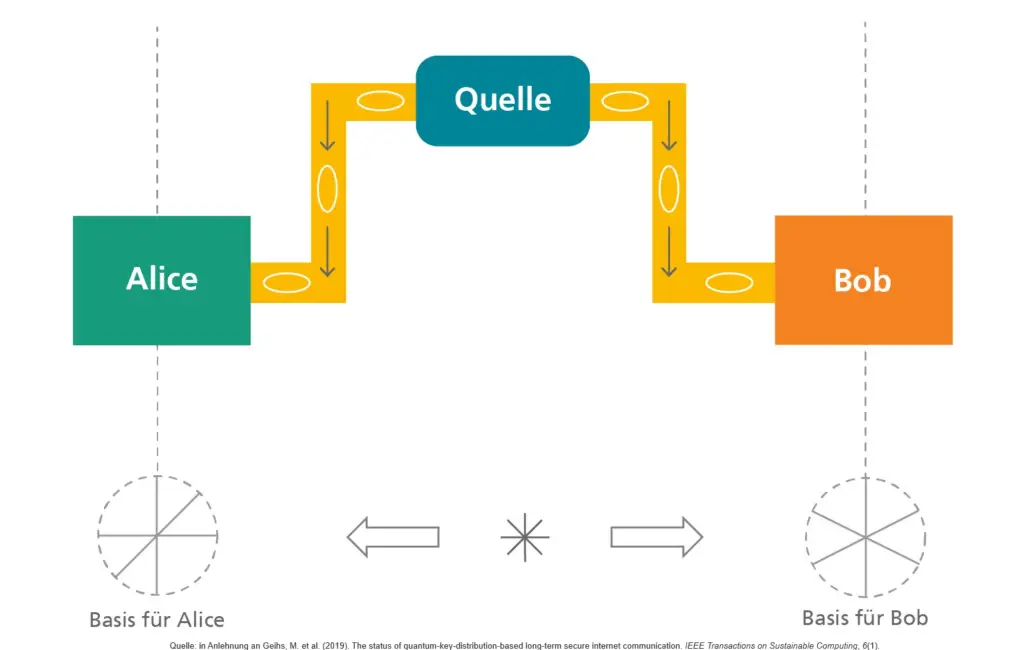
The E91 protocol, developed by Artur Ekert (1991), uses the Quantum entanglement, a fascinating phenomenon in which two quantum objects are in a state that links their properties, regardless of the distance between them. In this protocol, Alice generates a pair of entangled photons and sends one to Bob. Alice and Bob measure the photons in random directions. Since the photons If they are entangled, their measurement results will be perfectly correlated as long as there is no eavesdropping. These correlations can be used to generate a secret key. An attempt to eavesdrop would Entanglement interfere with them and thereby alter the correlations, which the communication partners notice.
Strengths:
- Provides additional security through its entanglement properties
- Can prove that an attempt was made to eavesdrop
BBM92 Protocol
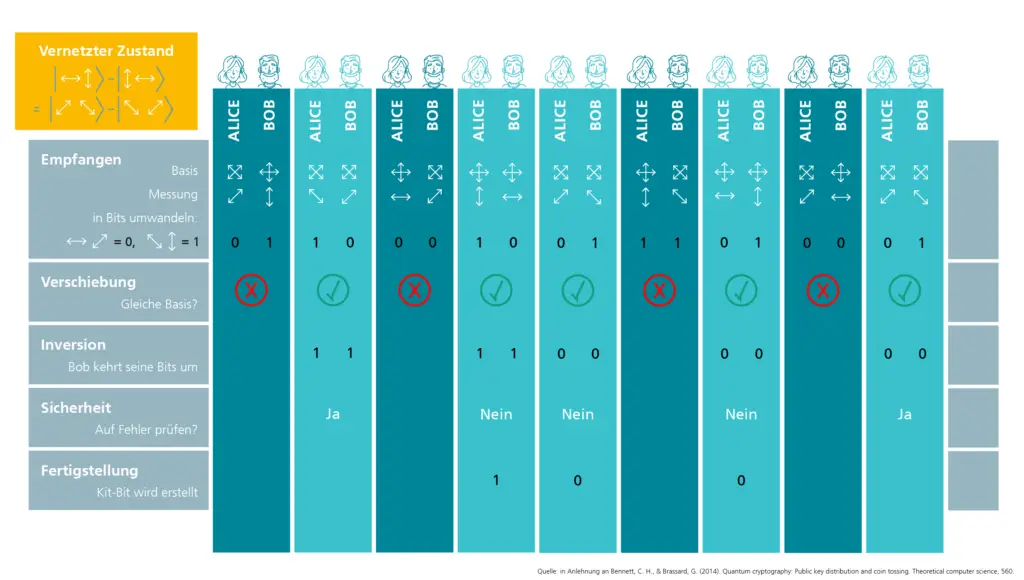
The BBM92 protocol was developed by Charles Bennett, Gilles Brassard, and Nicolas Gisin (1992) and is an extension of the BB84 protocol, which is also based on the Quantum entanglement is based on. Unlike the BB84 protocol, BBM92 uses entangled photon pairs. Alice and Bob each receive one of the entangled photons and measure them in random azimuths. Similar to the E91 protocol, the measurements are affected by the Entanglement correlated. The two parties can use these measurements to generate a shared key. The BBM92 protocol benefits from the Entanglement, to provide security proofs and to offer a robust method for error detection during key distribution.
Strengths:
- Take advantage of entanglement for additional security guarantees
- Combines principles from BB84 and the Quantum entanglement
Sources
Bennett, C. H., & Brassard, G. (1984). „Quantum cryptography: Public key distribution and coin tossing.“ Proceedings of IEEE International Conference on Computers, Systems and Signal Processing.
Ekert, A. K. (1991). „Quantum cryptography based on Bell’s theorem.“ Physical Review Letters, 67(6), 661-663.
Bennett, C. H., Brassard, G., & Mermin, N. D. (1992). „Quantum cryptography without Bell’s theorem.“ Physical Review Letters, 68(5), 557-559.