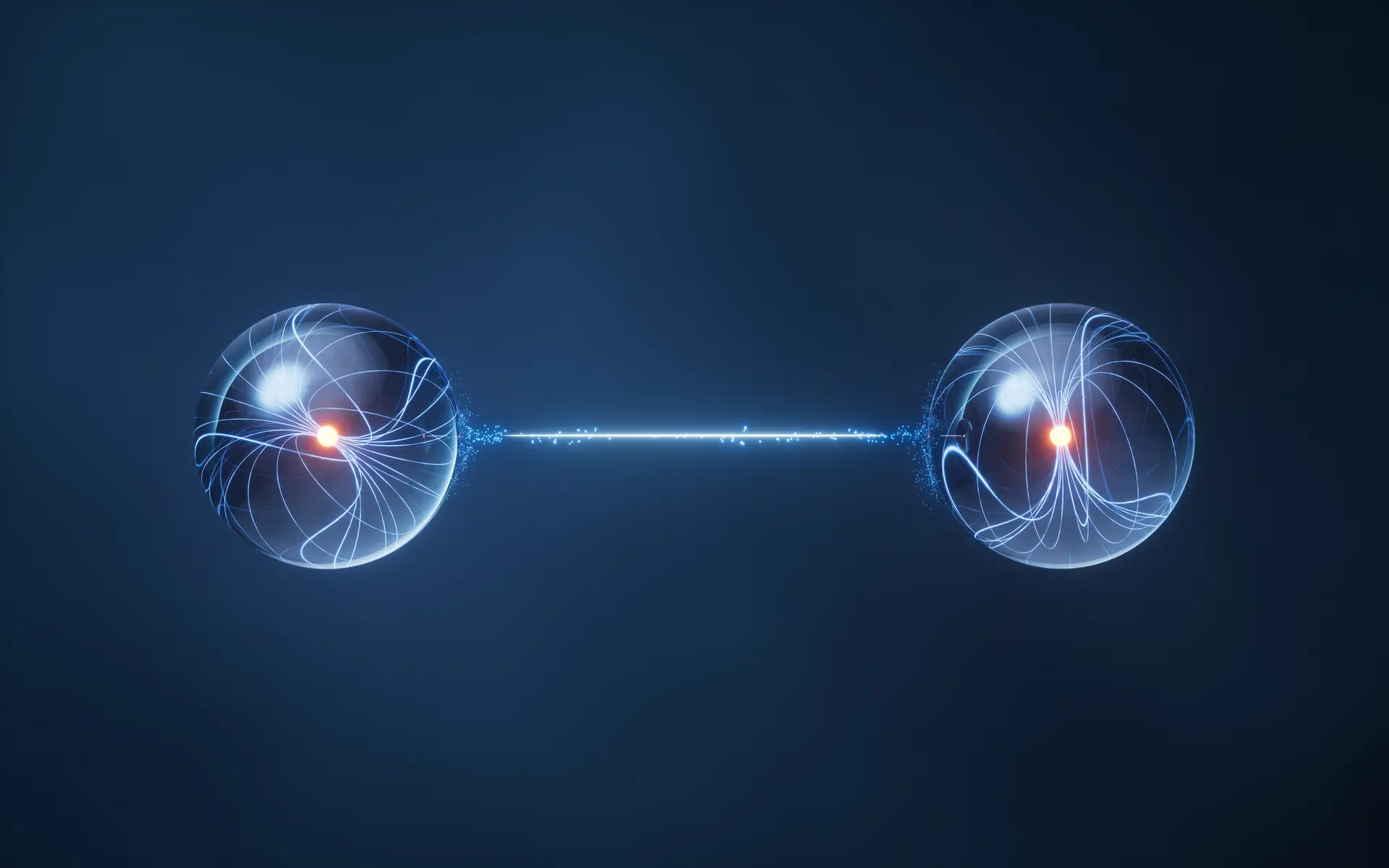
The Quantum entanglement is one of the most fascinating phenomena in quantum mechanics. It describes a situation in which two or more quantum particles, for example, photons or electrons, are brought into a shared state. Their properties are so closely linked that measuring one particle immediately affects the state of the other—regardless of the distance between them. This behavior contradicts the classical notion that objects can only be influenced by their immediate surroundings.
Albert Einstein himself described the Quantum entanglement as a “spooky action at a distance,” since, in his view, The Theory of Relativity seemed to contradict the principle that nothing can travel faster than light. Nevertheless, numerous experiments—in particular the Bell test—have shown that entangled particles share information in a way that cannot be explained by classical physics. A groundbreaking experiment by Alain Aspect in the 1980s confirmed that the Bell's Inequalities be injured and thus the Quantum entanglement eine physikalische Realität ist.
Basic Principles of Quantum Entanglement
- Non-locality: The properties of entangled particles cannot be described independently of one another. A measurement on one particle instantly affects the other.
- Inseparable States: Entangled particles share a common quantum state that cannot be broken down into the individual states of the particles.
- Superposition: Quantum particles can exist in multiple states at the same time. These states are described by a wave function.
- Conservation of Quantum Properties: In entangled systems, certain physical quantities, such as the Total spin, is determined. When the spin of one particle is measured, the spin of the other is immediately determined.
- Consistent Measurements: When a property of an entangled particle is measured, the wave function of the entire entangled system collapses into a specific state.
- Decoherence: Quantum-entangled states are sensitive to environmental influences. Interactions with the environment can cause the particles to behave like classical particles.
Applications of Quantum Entanglement
The Quantum entanglement is a revolutionary technology that enables numerous applications in science and technology. It is particularly significant in the Quantum Cryptography, Quantum Computers and Quantum Metrology.
In the Quantum Cryptography will be the Quantum entanglement used to create absolutely secure communication channels. A well-known method is the Quantum Key Distribution (QKD). In this process, entangled particles are exchanged between two communication partners, allowing any attempt to eavesdrop on the communication to be detected immediately. This method therefore offers virtually unbreakable security that far exceeds the capabilities of traditional encryption techniques.
Also in the development of Quantum Computers plays the Quantum entanglement a crucial role. While traditional computers with Bits Use bits that can take on either the value 0 or 1 Quantum computer qubits. These can, thanks to Superposition and Entanglement exist in many states simultaneously and enable parallel computations. This allows Quantum computer solve certain problems, such as the simulation of chemical reactions or optimization tasks, significantly faster than traditional computers.
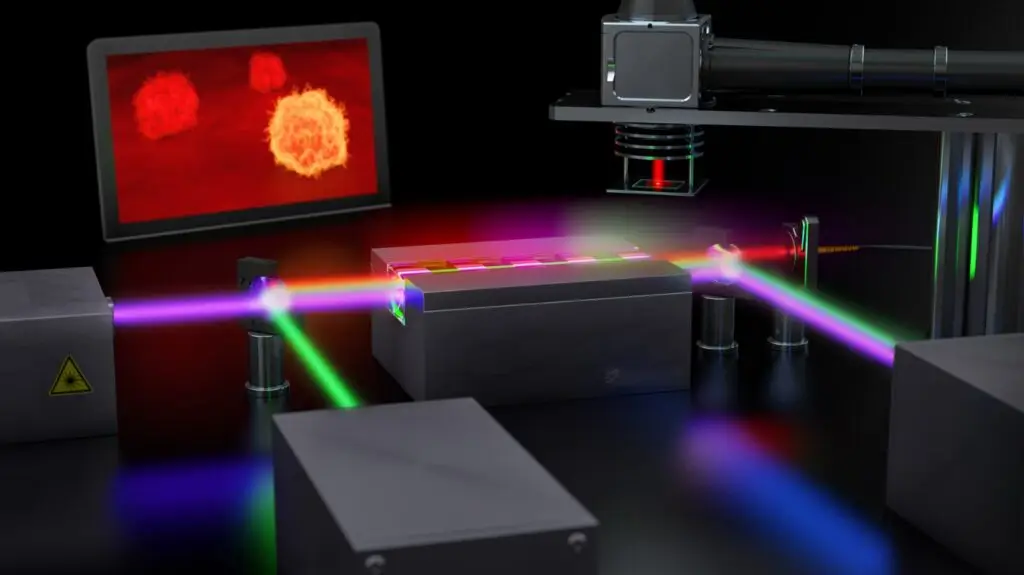
In the Quantum Metrology, another promising field, the Quantum entanglement used to perform extremely precise measurements. Among other things, this technology is used in the development of high-precision watches that can significantly improve the accuracy of GPS systems. In addition, quantum-entangled sensors are being developed that can measure weak magnetic fields with unprecedented sensitivity. Such sensors are used in medical imaging, particularly in the Magnetic Resonance Imaging (MRI), and in the study of brain activity.
Another fascinating concept is the Quantum teleportation, in which quantum information is transmitted from one location to another without the physical carrier having to bridge the distance. Researchers have already successfully Quantum teleportation conducted in the laboratory, and this technology could form the basis for a future quantum internet that offers unprecedented security and efficiency in data transmission.
The Quantum entanglement It is not only a fascinating physical phenomenon, but also a driving force behind technological innovations that could transform our lives. Its applications range from secure communication to powerful computers and precise measuring instruments. Research in this field is advancing rapidly, and in the future, even more far-reaching applications could emerge that deepen our understanding of the quantum world and open up new possibilities.