In the world of science and technology, there are always developments that can be described as groundbreaking. One such innovation is quantum imaging, a technology based on the principles of quantum mechanics that has the potential to fundamentally transform imaging in a wide variety of fields. From medical diagnostics to materials research and biological processes, quantum imaging promises to reveal things that were previously hidden. But how does this technology work, and what specific applications and challenges are associated with it?
What is quantum imaging?
Quantum imaging is an advanced imaging technique that takes advantage of the unique properties of quantum objects, in particular photons, takes advantage of. Unlike in classical physics, where light and other forms of electromagnetic radiation are regarded as waves or particles, quantum imaging makes use of quantum mechanical Entanglement and other quantum phenomena to generate images that would not be possible using traditional methods. A central aspect of quantum imaging is the Quantum entanglement. This unique property makes it possible to obtain image information about objects without having to directly irradiate the object under examination with light or radiation.
Imaging with Entangled Photons: A Quantum Leap
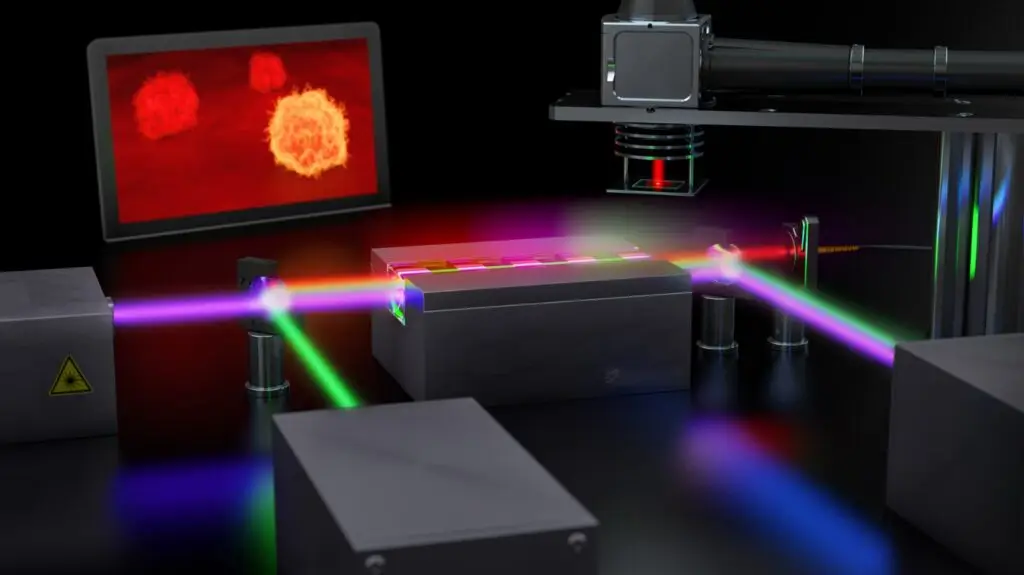
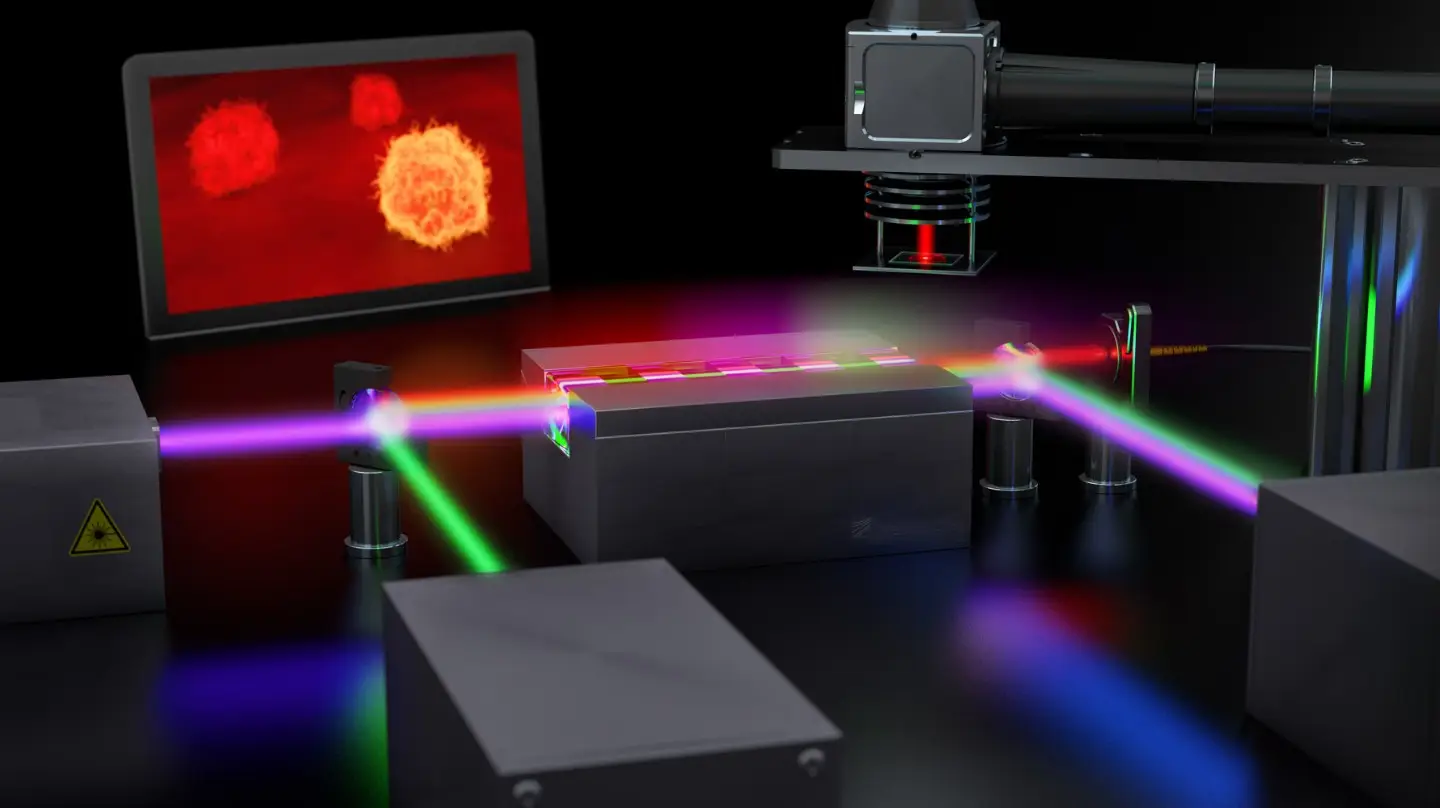
The use of interlaced photons is one of the most fascinating aspects of quantum imaging. In this method, pairs of photons are generated that are entangled with one another. In traditional imaging, such as X-ray technology or microscopy, light (or another form of radiation) is directed directly at an object. The light is then scattered or reflected by the object, and these altered light beams are detected to produce an image. However, this method has its limitations: it can damage the object (especially in the case of living cells), require high radiation doses (as with X-rays), or simply fail to provide the resolution needed to reveal very fine details. This is where entangled photon pair generation comes into play, which addresses the described “Quantum leap“in medical imaging. In this procedure, two photons generated simultaneously and are intertwined with one another. Photon 1, also known as a signal photon, is emitted toward the object being examined. It can, for example, pass through the object or be reflected by it, similar to conventional imaging techniques. Photon 2, also known as an idler photon, is redirected in a different direction—typically straight toward a detector—without ever touching the object. At first glance, it may seem surprising that the Photon, which does not come into contact with the object (Photon 2), yet still provides information about the object. This is thanks to the Quantum entanglement possible. If the signal photon (Photon 1) When you interact with the object and its properties are altered in the process, its entangled counterpart (Photon 2) is also affected. The detector that captures the idler photon can then gather information that creates an image of the object, even though the object Photon has never touched the object. This entire process offers several advantages:
- Less Radiation Exposure: Since the image information is captured via the idler photon, which never directly contacts the object, the amount of radiation that actually strikes the object can be significantly reduced. This is particularly important in medical imaging, where the goal is to minimize radiation exposure for patients.
- Greater precision: Then he crossed his arms photons Because they are interconnected in a very delicate way, even very fine details that could not be detected using conventional methods can be made visible. This could be crucial in medical diagnostics for the early detection of tiny tumors or other abnormalities.
- Non-invasive: The fact that the idler photon does not require direct interaction with the object means that quantum imaging is non-invasive and causes less potential damage, especially to sensitive biological samples.
This method actually represents a Quantum leap in the field of imaging because it represents a fundamental departure from conventional imaging methods. The ability to generate highly precise images without directly affecting the object opens the door to new applications that were previously unthinkable. It’s not just about better images, but also about generating them in a way that is safer, more efficient, and, in many cases, more accurate than anything that was previously possible.
Challenges and Future Prospects of Quantum Imaging
Despite its enormous potential, quantum imaging is still in its infancy. One of the biggest challenges is to translate the theoretical concepts in practical applications to convert. The creation and handling of interleaved photons require highly complex technologies and extremely precise measuring instruments. Furthermore, integrating these technologies into existing imaging methods is a challenging task.
Another problem is the Scalability. While quantum imaging has already yielded impressive results in laboratory settings, it remains to be seen how well these technologies can be scaled up for larger, commercial applications. Developing robust and cost-effective quantum imaging devices could take several years, but the potential benefits make this challenge worthwhile.
A New Era in Imaging
Quantum imaging represents a significant advance in science and technology. By harnessing the principles of quantum mechanics, this technology could fundamentally change the way we view the world around us. From the medical field to materials science and biological research, quantum imaging is opening up new horizons that push the boundaries of imaging beyond what was previously possible. The future of quantum imaging is promising, and the progress already made suggests that this technology will continue to gain importance in the coming years. Although there are still some challenges to overcome, there is no doubt that quantum imaging will open the door to a new era of scientific discoveries and technological innovations.