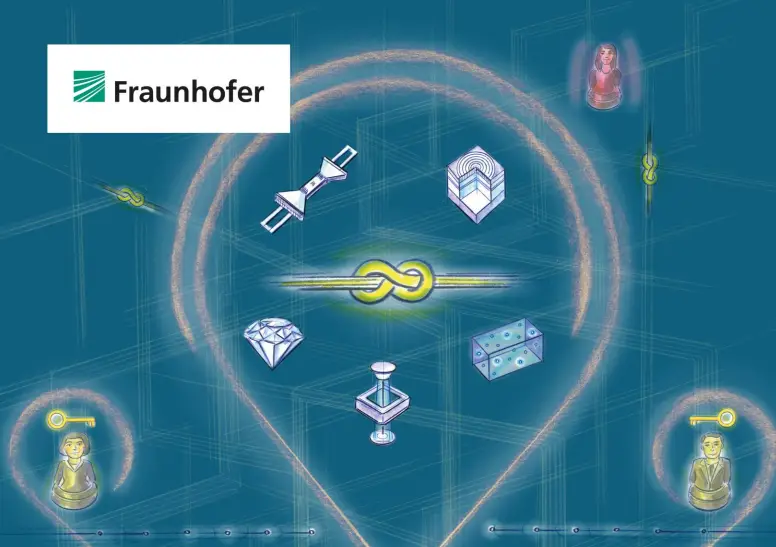
Quantum repeaters could play a key role in building future quantum networks. This is because quantum information cannot simply be copied or amplified like a classical telecommunications signal. As a result, losses increase with distance. Quantum repeaters are designed to overcome this limitation by gradually spreading so-called entanglement over greater distances.
A new roadmap from Fraunhofer ISI and Saarland University shows how far development has progressed and what steps still need to be taken. To this end, scientific studies were analyzed and experts from academia and industry were surveyed. Various technical approaches were examined, such as those using atoms, ions, quantum dots, or color centers in diamond. So far, none of these platforms has clearly emerged as the dominant one. They differ, among other things, in terms of storage time, efficiency, and technical scalability.
Quantum repeaters—which transmit information with lower losses than a direct connection—could be demonstrated as early as 2035. However, there is still much work to be done before they can be widely deployed in practice: Among other things, more powerful quantum storage devices, higher transmission rates, and solutions for integrating them into existing telecommunications networks are needed.
As a first application, quantum repeaters could extend the range of quantum key distribution. In the long term, they could also connect distant quantum computers or enable high-precision sensor networks. This would make them an important building block on the path to a potential “quantum internet.
—
For more information, visit: Fraunhofer ISI
Image: © Fraunhofer ISI