Quantum physics is the foundation of many cutting-edge technologies, including quantum communication. This branch of physics deals with the smallest units of matter and energy, known as Quanta, and helps us understand how they work on the subatomic level act.
What are quanta?
Quanta are extremely small units of energy that are used in the subatomic world have an effect. A well-known example is the Photon, the smallest unit of light. What makes Quanta is that they occur in specific, fixed quantities, a phenomenon known as “quantization.” This discrete nature of the Quanta is particularly evident in the way Atoms and Electrons be able to absorb and release energy. Unlike in classical physics, where energy is considered to be continuous, Electrons in Atoms occupy only specific energy levels. When they absorb energy in the form of a photons When you record, they jump back and forth between these levels—this is called a Quantum leap. This property is crucial to the functioning of many quantum technology applications, including quantum communication.
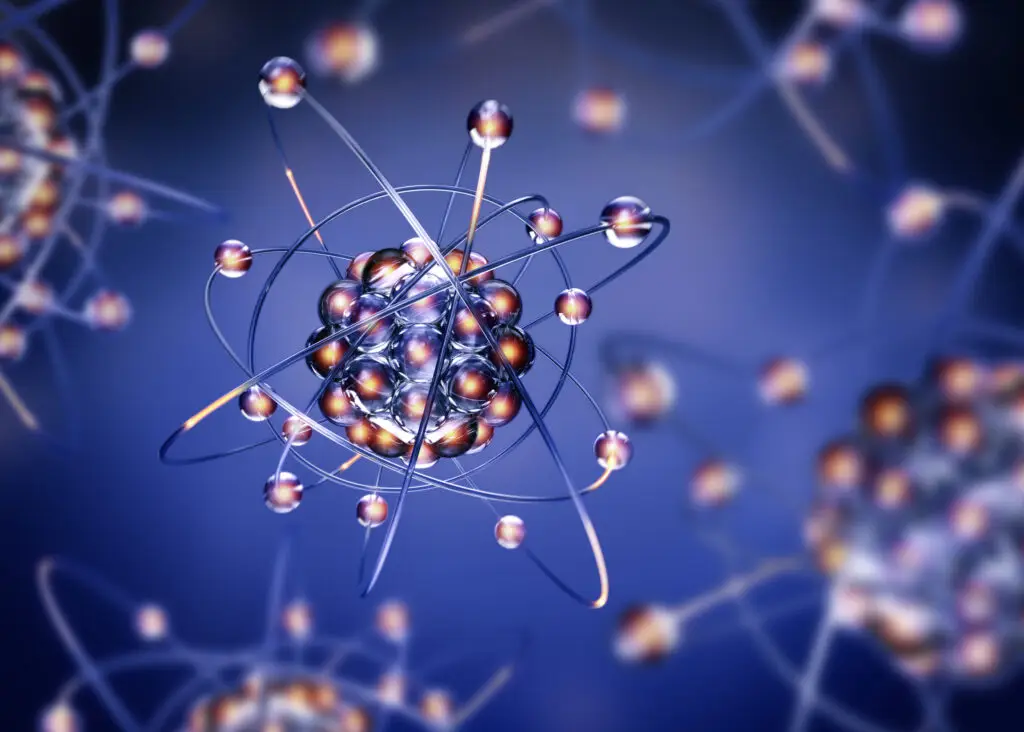
Atoms are the basic building blocks of matter and consist of a positively charged nucleus and negatively charged electrons that orbit the nucleus. These Electrons bewegen sich jedoch nicht willkürlich, sondern nur in festgelegten Bahnen, die durch den Energiezustand des electrons be determined. Quanta such as photons can be Electrons influence them by transferring energy to them. This causes the electron jumps to another, higher energy level. Such interactions are typical of quantum systems and form the basis for many technological developments, including quantum communication.
Wave-particle duality
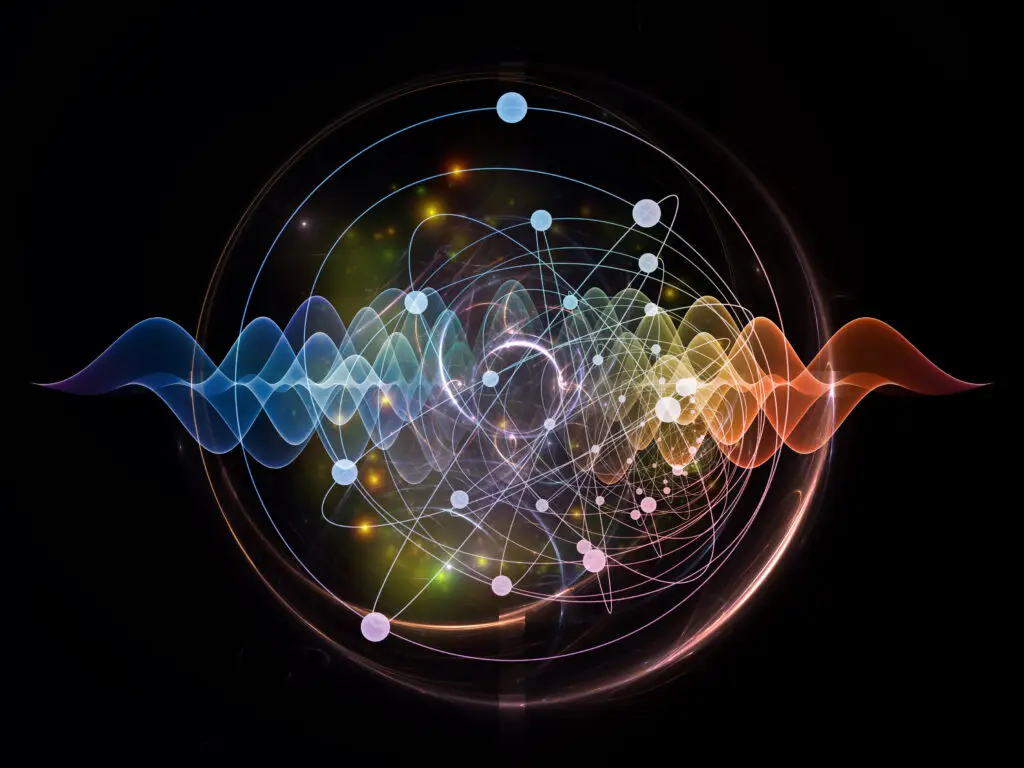
One of the most fascinating discoveries in quantum physics is the dual nature of quantum objects. They can behave both as particles and as waves. This “wave-particle duality” becomes particularly evident when conducting experiments in which Electrons or photons passed through a narrow slit. Under these conditions, they sometimes exhibit the properties of particles that are clearly localized at a specific point, and sometimes they behave like waves that interfere with one another. This behavior is a fundamental property of Quanta and plays an important role in quantum communication, as the way information is transmitted is influenced by this dual nature.
Das berühmte Doppelspaltexperiment veranschaulicht die erstaunlichen Eigenschaften von Quanta. Ursprünglich von Thomas Young mit Lichtquanten, den photons, durchgeführt, lässt sich das Experiment so vorstellen: Ein Spieler schießt mehrere Bälle mit verbundenen Augen auf eine Wand mit zwei Spalten. Hinter der Wand steht ein Detektor, der festhält, wo die Bälle landen. Erwartungsgemäß zeigt der Detektor zwei Linien, da die Bälle durch die beiden Spalten fliegen. Im Nanocosmos verhalten sich jedoch Quanta anders. Wenn die photons nicht beobachtet werden, zeigen sie ein Interferenzmuster – ähnlich wie Wellen, die sich gegenseitig verstärken oder abschwächen. Selbst wenn die photons einzeln durch die Spalten fliegen, erscheint das gleiche Muster. Das bedeutet, dass ein Photon durch beide Spalten gleichzeitig gehen und mit sich selbst interferieren kann. Sobald jedoch ein Beobachter misst, durch welchen Spalt das Photon fliegt, verschwindet das Interferenzmuster. Die photons verhalten sich dann wie klassische Teilchen, und es sind nur zwei Trefferlinien zu sehen. Dies zeigt: Durch die Beobachtung wird die Welleneigenschaft gestört, und das Photon muss sich entscheiden, welchen Spalt es durchquert. Dieser Effekt gehört zu den faszinierendsten Phänomenen der Quantenwelt.
The Uncertainty Principle and Its Significance
Ein weiteres zentrales Konzept der Quantenphysik ist das Heisenberg's Uncertainty Principle. This principle states that certain properties of a quantum object, such as position and momentum, cannot be determined simultaneously with arbitrary precision. The more precisely one attempts to measure one of these properties, the less precise the other becomes. This is particularly relevant in quantum communication, since measuring a quantum object alters the state of the system. As a result, it is theoretically impossible to communicate in a tap-proof manner without an eavesdropping attempt altering the state of the system and thus being detected.
Innovation through groundbreaking technologies
Quantum physics, which deals with the smallest units of matter and energy, forms the basis for numerous technological breakthroughs. Quantum technologies harness the unique properties of quantum mechanics to open up new possibilities in fields such as communications, computing, and measurement technology. Quantum technologies are based on the principles of quantum mechanics and, through the manipulation of Quanta entirely new applications. They enable technologies such as high-precision measurements, secure communication systems, and extremely powerful computers. These technologies can be divided into two generations, which differ in the extent to which quantum mechanical properties are utilized in practice.
First-generation quantum technologies are based on collective quantum effects and have been used for decades in everyday technologies such as lasers, GPS, and atomic clocks. These technologies utilize quantum mechanical phenomena on a general level, without involving individual Quanta to manipulate them in a targeted manner. The second generation of quantum technologies, on the other hand, goes a step further by enabling the targeted control of individual quantum systems. Examples of this include quantum computers, which could solve certain computational problems significantly faster, as well as the Quantum cryptography, which promises absolutely secure communication. The application of phenomena such as superposition and entanglement opens up new possibilities in various industries and fields of research.
Sources
Demtröder, W. (2014). Einführung in die Quantenmechanik. Springer Vieweg.
Horizonte. Quantentechnologien. (2020). acatech – Deutsche Akademie der Technikwissenschaften.